
Modern IT environments are detecting hundreds or thousands of vulnerabilities across endpoints, apps, servers, cloud workloads, and network infrastructure. The need of the hour has become deciding which weaknesses need attention first, getting them fixed, and making sure they stay fixed.
A vulnerability management process provides IT teams an actionable way to move from vulnerability discovery to prioritization, remediation, and verification instead of treating every scan as an isolated security exercise.
This blog explains how the vulnerability management process works, the challenges teams commonly face, and the practices that can make it more effective.
What is a vulnerability management process?
A vulnerability management process is a continuous approach to identifying, assessing, prioritizing, remediating, and monitoring security weaknesses across an organization’s IT environment.
Unlike a point-in-time vulnerability assessment, a vulnerability management process establishes an ongoing cycle for finding exposures, deciding which ones warrant action, addressing them, and verifying the results.
Depending on the scope of the program, findings may include known software and operating system vulnerabilities, missing patches, insecure configurations, exposed services, and other weaknesses identified across the environment.
Why is a vulnerability management process important?
As organizations continuously add apps, endpoints, and cloud services to their environments, manually identifying and addressing every weakness becomes increasingly difficult.
An effective vulnerability management process helps organizations:
- Reduce exposure to known threats: Identifying and addressing vulnerabilities limits opportunities attackers can use to compromise systems.
- Prioritize remediation efforts: Security teams can focus resources on vulnerabilities that present the greatest technical and business risk instead of treating every finding equally.
- Improve asset visibility: Regular discovery and assessment help organizations understand which systems, apps, and devices are present in their environments.
- Support security and compliance programs: A consistent vulnerability management process can help organizations address vulnerability-related controls, demonstrate remediation activity, and provide evidence that supports broader security frameworks and standards such as CIS Controls and ISO 27001.
- Strengthen security posture over time: Measuring remediation progress and recurring weaknesses helps security teams continuously refine their defenses.
Vulnerability management lifecycle: Key steps
A vulnerability management is the structured workflow organizations use to discover vulnerabilities, understand their risk, remediate them, and verify that corrective actions were successful.
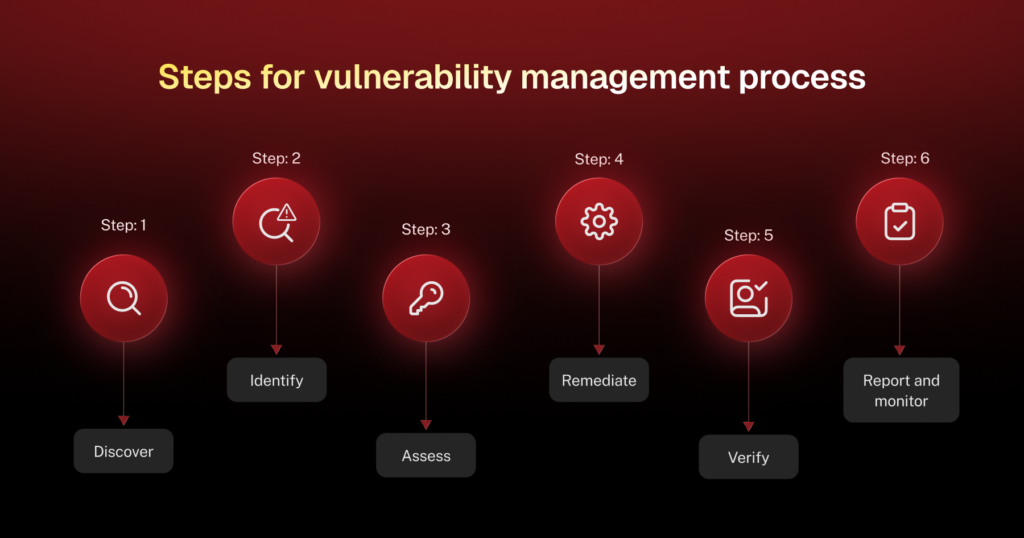
Although organizations may structure their process differently, it generally follows a continuous lifecycle comprising the following steps:
Step 1: Discover and inventory assets
A vulnerability management process begins with understanding what needs to be protected. Organizations identify and maintain an inventory of endpoints, servers, apps, network infrastructure, cloud workloads, and other systems within their environment.
A maintained inventory gives IT and security teams better visibility into the assets that need protection. It also reduces the risk of unmanaged systems remaining outside regular vulnerability assessments. Asset inventories should also be continuously updated as new systems are deployed or removed.
Step 2: Scan and identify vulnerabilities
Once all assets are identified, vulnerability scanners and management tools can assess them for weaknesses such as missing patches, vulnerable software versions, insecure configurations, or known Common Vulnerabilities and Exposures (CVEs).
Scanning should cover as much of the IT environment as possible and occur regularly. In dynamic environments, relying entirely on occasional scans can leave newly introduced vulnerabilities unnoticed between assessment periods.
However, vulnerability detection alone does not determine what should be fixed first. The findings must first be evaluated in context.
Step 3: Assess and prioritize vulnerabilities
Not every vulnerability represents the same level of risk. Security teams can combine several signals when deciding what to address first. CVE records provide standardized vulnerability identifiers, and the Common Vulnerability Scoring System (CVSS) assigns technical severity scores. On the other hand, the Exploit Prediction Scoring System (EPSS) estimates exploitation likelihood, while the CISA Known Exploited Vulnerabilities (KEV) catalog identifies vulnerabilities with evidence of active exploitation.
These signals become more meaningful when considered alongside factors such as:
- Whether the vulnerability is actively exploited
- How easily attackers can exploit it
- The criticality of the affected asset
- Whether the system is internet-facing
- The data or business functions affected
- Existing security controls that reduce the risk
This risk-based approach prevents teams from spending equal effort on thousands of findings with very different potential consequences.
Step 4: Remediate or mitigate vulnerabilities
After vulnerabilities have been prioritized, teams need to determine the appropriate response. Remediation removes the vulnerability itself. This might involve installing a security patch, upgrading vulnerable software, correcting a configuration, or retiring an outdated system.
However, sometimes immediate remediation is not possible. A vendor patch may not yet exist, or applying an update could disrupt a critical app. In these cases, organizations can mitigate the risk through measures such as network segmentation, access restrictions, configuration changes, or additional security controls.
Remediation timelines should reflect the actual risk associated with each vulnerability rather than applying the same deadline to every issue.
Step 5: Verify remediation
Applying a patch or changing a configuration does not automatically mean the vulnerability has been resolved.
Affected assets should be reevaluated after remediation. Verification confirms that the original vulnerability is no longer present. It also helps identify cases where patches failed, configurations were incorrectly applied, or remediation introduced another issue. Without this step, security teams may close vulnerability tickets while the underlying exposure remains.
Step 6: Report and continuously monitor
The vulnerability management lifecycle does not end after remediation. Security teams should continuously monitor their environments for newly discovered vulnerabilities while tracking how effectively existing vulnerabilities are being addressed.
Reporting can include metrics such as mean time to remediate (MTTR), remediation backlog, scan coverage, and the percentage of critical vulnerabilities resolved within defined service-level agreements (SLAs). These insights help teams identify bottlenecks, measure improvements, and refine the workflow over time.
Challenges of creating a vulnerability management process
Building a vulnerability management workflow may appear straightforward, but maintaining it consistently across a large or changing IT environment introduces several challenges.
- Discovery challenge: Incomplete asset visibility: Unknown, unmanaged, remote, or cloud-based assets can remain outside vulnerability scans and create blind spots.
- Discovery challenge: Changing IT environments: New endpoints, apps, cloud workloads, and services can be added continuously, making static asset inventories and infrequent scans quickly outdated.
- Prioritization challenge: Too many vulnerability findings: Large environments can generate more vulnerabilities than security teams have the time or resources to remediate, making prioritization essential.
- Assessment challenge: Difficulty in determining real risk: A high severity score does not always mean a vulnerability represents the greatest risk to a specific organization. Asset criticality, exploitability, exposure, and existing controls also matter.
- Remediation challenge: Ownership gaps: Security teams often identify vulnerabilities while IT, app, infrastructure, or DevOps teams are responsible for resolving them. Unclear ownership can delay remediation.
- Remediation challenge: Operational disruption: Patching or upgrading critical systems may require testing, maintenance windows, or app compatibility checks before changes can be safely deployed.
- Operational challenge: Limited security resources: Maintaining continuous scanning, triaging findings, coordinating remediation, and validating fixes can require significant technical expertise and operational capacity.
- Validation challenge: False positives and noisy findings: Scanner results may sometimes require additional validation before security teams can determine whether a vulnerability actually affects a particular asset.
Best practices for an effective vulnerability management process
A mature vulnerability management program becomes more effective when the following activities are integrated into everyday IT and security operations rather than treated as isolated scanning exercises.
- Maintain an accurate asset inventory: Keep an up-to-date inventory of hardware, software, endpoints, servers, cloud resources, and other infrastructure. Assets that are unknown to security teams can also remain outside vulnerability assessments.
- Prioritize based on risk, not severity alone: Avoid automatically fixing vulnerabilities based only on their CVSS score. Instead, combine the score with asset importance, exposure, and potential business impact. This gives teams a clearer picture of which vulnerabilities deserve immediate attention.
- Define remediation ownership and SLAs: Every vulnerability should have a clear remediation owner. Organizations can also establish SLAs based on risk. For example, actively exploited vulnerabilities affecting critical systems should generally receive faster remediation targets than low-risk weaknesses on isolated systems.
- Scan continuously or at an appropriate frequency: Scanning once or twice a year cannot provide an accurate picture of a continuously changing IT environment. Use recurring or continuous assessments where practical. Adjust scanning frequency according to asset criticality and how rapidly the environment changes.
- Automate repetitive activities: Where supported, automation can reduce repetitive work across vulnerability scanning, ticket creation, patch deployment, remediation workflows, and reporting. In practice, these activities may be handled by different security, IT operations, and endpoint management tools working together. This allows security teams to spend more time investigating higher-risk issues.
- Keep security and IT teams aligned: Vulnerability management doesn’t have to be a one-man show. Security may identify and prioritize vulnerabilities, while IT operations, infrastructure teams, app owners, and developers perform remediation. Shared workflows, ownership rules, and escalation processes help prevent vulnerabilities from falling through the cracks between teams.
- Verify every remediation: Do not consider a vulnerability resolved simply because a patch or configuration change was deployed. Rescan or reassess affected systems to confirm that remediation succeeded and that the vulnerability is no longer present.
- Use current vulnerability and threat intelligence: Vulnerability information changes as exploits become available and attackers begin targeting particular weaknesses. Combining scanner findings with updated vulnerability databases, known exploit information, and threat intelligence makes prioritization more responsive to real-world risk.
- Track meaningful metrics: Vulnerability management metrics should show whether the process is actually reducing risk. Teams can monitor measures such as remediation time, critical vulnerabilities resolved within SLA, vulnerability backlog, asset coverage, recurring vulnerabilities, and overall risk reduction. Tracking these trends over time can reveal where processes need improvement.
Strengthen vulnerability management from discovery to remediation
Vulnerability management is not simply about running scans and generating a list of weaknesses. Its value comes from creating a repeatable process for discovering vulnerabilities, prioritizing them based on risk, coordinating remediation, verifying fixes, and measuring whether exposure is decreasing over time.
For organizations looking to strengthen the endpoint side of this effort, Veltar brings endpoint security and automated compliance capabilities into the Scalefusion platform. IT teams can monitor endpoint compliance and remediate supported compliance deviations. This helps keep managed devices aligned with defined security baselines as part of a broader vulnerability and security management strategy.