

Zebra devices are built for frontline work, but their value depends on how well they are deployed, secured, and managed. In warehouses, hospitals, retail stores, and field operations, even a small device issue can slow down work, create security risk, or interrupt service.
That is where Zebra device management becomes essential.
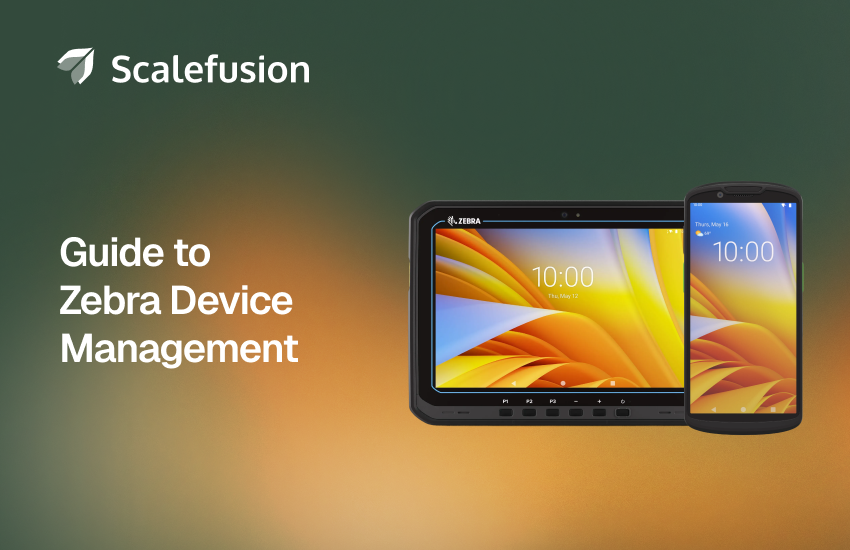
A strong Zebra device management solution gives full control, letting teams monitor device health, push updates, and resolve issues before they disrupt operations. With proactive management, devices stay reliable, secure, and productive, no matter how tough the conditions.
With the right Zebra device MDM solution, businesses can track, secure, and update every Zebra device remotely. A reliable MDM solution for Zebra devices cuts down support costs, improves device uptime, and keeps sensitive business data safe.
Let’s explore what is a Zebra device is, the different types of Zebra devices, and how to effectively manage them using Zebra mobile device management solutions.
What is Zebra device management?
Zebra device management is the centralized control of Zebra rugged devices across enterprise fleets, enabling IT teams to operate more efficiently and securely. With the ability to enroll devices at scale without manual setup, apply security policies remotely, push business apps and updates instantly, monitor device health and usage, and support users without physical access, organizations can streamline operations significantly. For businesses managing large fleets, Zebra device management is not just about device administration—it’s about maintaining consistency, security, and efficiency in frontline operations.
What are Zebra devices used for?
Zebra devices are built for more than just durability, they help businesses run faster, smarter, and more accurately. These rugged devices are used across industries like logistics, retail, manufacturing, and healthcare. Here’s how companies use Zebra devices in real-world operations:
1. Barcode Scanning and Printing
Zebra devices are widely used for scanning barcodes and printing receipts or labels. In retail and logistics, barcode scanners quickly capture product details like name, price, or ID, and mobile printers generate printed receipts or tracking labels instantly. This speeds up billing and reduces human errors, helping businesses improve customer satisfaction. It also improves inventory accuracy and asset tracking.
2. Inventory Management
Managing stock manually takes time and can lead to mistakes. With Zebra mobile devices like handheld computers and tablets, businesses can update inventory records in real time. These devices are used in warehouses, hospitals, and retail stores to check stock levels, track low inventory, and make restocking decisions faster which helps to improve inventory management.
3. Workforce Management
In industries like transportation, field services, and logistics, Zebra devices help businesses manage employees out in the field. Real-time location tracking keeps managers informed on where the devices and the workers are. Teams can communicate quickly, complete tasks faster, and respond to customer needs without delay.
4. Asset Tracking
Tracking high-value assets is critical, especially in healthcare and logistics. Zebra devices use barcode scanning and RFID readers to monitor the location and status of equipment or supplies. Hospitals use Zebra mobile device management to track medical tools and ensure they’re available when needed. In logistics, businesses use the same tech to track packages and shipments every step of the way, reducing losses and improving delivery accuracy with real-time visibility.
With the right Zebra device MDM in place, organizations can keep all devices secure, up to date, and performing at their best, no matter how challenging the environment.
Keep your Zebra devices up and running with Scalefusion
Why Zebra device management matters
Managing a few devices manually may be manageable. Managing dozens, hundreds, or thousands of rugged endpoints across multiple locations is a different story. When devices are not centrally managed, teams often deal with inconsistent configurations, delayed updates, and avoidable downtime.
Zebra device management solves that by giving IT teams visibility and control. It helps ensure that every device is ready for work before it reaches the user. It also reduces the time spent on repetitive setup tasks and gives support teams a way to respond quickly when something goes wrong.
This matters especially in environments where every minute counts. In retail, a misconfigured device can slow down checkout. In healthcare, it can interrupt access to critical information. In logistics, it can stall scanning and shipping workflows. In field service, it can leave workers without the tools they need to complete jobs on time.
Key features of a Zebra management solution
A modern Zebra MDM solution should do more than just list devices on a dashboard. It should simplify the entire lifecycle of the fleet.
1. Zero-touch enrollment
This is one of the biggest wins in Zebra device deployment. Devices can be enrolled automatically with predefined settings, which reduces manual work and helps IT teams get new devices into use much faster.
Also read: Zebra Device Enrollment Methods and Setup Guide
2. Policy and security enforcement
A good rugged device management platform should let IT teams enforce passwords, restrict access, configure Wi-Fi and VPN profiles, and apply compliance rules remotely. That keeps devices aligned with company policy even when they are spread across multiple sites.
3. App management
Business apps need to be pushed, updated, or removed without relying on users to do it themselves. With centralized app management, IT teams can make sure every Zebra device has the right tools at the right time.
4. Remote troubleshooting
When a device stops working properly, support teams should be able to view, control, or guide the device remotely. That saves time, reduces truck rolls, and helps frontline teams get back to work sooner.
5. StageNow
Enroll all Zebra devices in one go with StageNow. Push updates, security policies, and other configurations using StageNow MXconfigs, ensuring standardized setups across entire Zebra device fleet.
6. DataWedge
Leverage DataWedge to scan barcodes and capture data from peripherals like magnetic stripe readers (MSR) and Bluetooth ring scanners, and send it directly to your applications.
7. Zebra OEMConfig
Leverage Scalefusion’s integrated Zebra OEMConfig, designed to give IT admins granular control over device configurations, security policies, performance optimizations, and advanced device-specific settings exclusively for Zebra devices.
8. LifeGuard OTA
Ensure seamless security and performance for your Zebra devices with LifeGuard OTA updates, powered by Scalefusion. Remotely deploy firmware, BIOS, and security patches across distributed devices.
Benefits of Zebra management
The biggest advantage of Zebra device management is consistency. Every device behaves more predictably when it is part of a centrally managed system. That reduces confusion for users and gives IT a cleaner operational model.
It also improves rollout speed. Whether a business is introducing ten new devices or a thousand, centralized enrollment and configuration reduce the friction that usually comes with scaling.
Security is another major benefit. Rugged devices often sit at the edge of the business, where they are used by warehouse staff, nurses, store associates, drivers, or technicians. That makes them valuable and vulnerable at the same time. Zebra device management helps close that gap by applying security settings, controlling access, and keeping software current.
Operationally, the payoff is clear. Teams spend less time on manual setup, support teams spend less time fixing repetitive issues, and frontline workers spend more time actually working. That is the kind of improvement that compounds over time.
How to choose the right Zebra management solution
Not every platform that supports Android devices is equally suited to rugged enterprise operations. The right Zebra device management platform should be able to handle bulk enrollment, strong policy controls, app management, remote support, and clear fleet visibility.
It should also be easy to administer. A platform that is powerful but difficult to use often creates more work than it saves. IT teams should look for a solution that can scale across locations without requiring constant manual intervention.
Compatibility matters too. Zebra device management works best when the platform can support the device models, OS versions, and workflows your business actually uses. That includes scanners, handhelds, mobile computers, tablets, and other frontline endpoints.
Security should never be an afterthought. The platform should support password rules, Zebra kiosk mode, app restrictions, remote wipe, and the ability to respond quickly if a device is lost or compromised.
Finally, support quality matters. When device issues affect frontline work, businesses need responsive help and clear documentation. The best platform is not only feature-rich, but also dependable in real-world deployments.
Simplify Zebra device management with Scalefusion
Managing a fleet of Zebra rugged devices doesn’t have to be complex. With Scalefusion Zebra Device Management, organizations gain a centralized, secure, and efficient way to monitor, control, and optimize their mobile devices. From seamless device enrollment and robust security to real-time location tracking and over-the-air updates, Scalefusion ensures your Zebra devices perform at their best while safeguarding critical business data. Simplify operations, boost productivity, and reduce downtime, all from a single powerful dashboard.
FAQs
1. How do you manage Zebra devices at scale?
The easiest way to manage Zebra devices at scale is to use a centralized MDM platform that supports enrollment, app management, security policies, and remote troubleshooting. That gives IT teams a repeatable way to handle large fleets without manually configuring every device.
2. What is the difference between Zebra device setup and Zebra device management?
Setup is the initial configuration of a device. Management is the ongoing process of controlling, securing, monitoring, and supporting that device after deployment. Setup is a moment in time. Management covers the full lifecycle.
3. What are the main challenges in Zebra device management?
The most common challenges are scale, inconsistent connectivity, legacy devices, user adoption, and limited visibility. These are best handled with automation, policy templates, careful segmentation, and a management platform built for rugged Android devices.
4. Can Zebra devices be managed remotely?
Yes. Zebra devices can be managed remotely through an MDM solution that supports remote support, policy enforcement, app distribution, and device monitoring. That helps IT teams solve problems without needing physical access.
5. Why do businesses use Zebra device management software?
Businesses use Zebra device management software to save time, reduce manual work, improve security, and keep frontline devices ready for daily operations. It is especially useful when devices are spread across multiple teams or locations.
6. How do I choose the right Zebra MDM solution?
Look for a platform that supports bulk enrollment, remote control, app management, policy enforcement, reporting, and strong support for rugged Android devices. It should also fit your workflows without adding complexity for IT or frontline staff.

