The best secure web gateway solutions help organizations protect users, devices, and data from web-based threats by filtering internet traffic, blocking malicious websites, enforcing access policies, and preventing risky downloads or data exposure. These platforms are useful for securing remote, hybrid, and office-based workforces by giving IT and security teams centralized control over how employees access the web.
Key Takeaways
The best Secure Web Gateway solutions help organizations secure everyday web access, reduce browser-based risks, and protect users across hybrid work environments.
- Web Access Is the New Attack Surface: As employees rely on browsers, cloud apps, and remote networks, SWGs help block phishing pages, malicious downloads, and unsafe web activity before damage occurs.
- Top SWG Vendors Compared: Leading Secure Web Gateway solutions in 2026 include Scalefusion Veltar, Check Point Harmony Connect, Cisco Umbrella, Cloudflare One, Netskope, Zscaler, Forcepoint ONE, and Fortra WebTitan.
- Core Capabilities to Look For: Strong SWG platforms combine URL filtering, HTTPS inspection, DNS security, SaaS visibility, DLP controls, threat intelligence, and policy-based web access enforcement.
- Hybrid Work Needs Consistent Protection: Modern SWGs secure users across office networks, home Wi-Fi, mobile hotspots, and unmanaged browsing environments without depending only on traditional VPNs or perimeter-based controls.
- Choose Based on Security Priorities: IT teams should evaluate SWG tools based on deployment model, remote workforce support, reporting, cloud app control, integration depth, and long-term scalability.
Web access has quietly become the most exposed part of enterprise security. In 2026, most work happens inside a browser. Employees log into cloud apps, upload files, collaborate through web tools, and switch networks multiple times a day. Offices are optional. Devices are mobile. Networks are no longer trusted by default.
This shift has created a simple problem: the web is now the primary attack surface.
Phishing pages look real. Malicious downloads hide behind legitimate URLs. Unsanctioned SaaS apps move company data without visibility. Traditional web filters were never designed for this level of complexity.
That’s why Secure Web Gateways are no longer optional.
This guide explains why SWGs matter more than ever in 2026, and the top 8 Secure Web Gateway solutions businesses should evaluate this year.
Why Secure Web Gateways matter in 2026?
Security once relied on a clear perimeter. If users were inside the corporate network, web access was considered relatively safe and loosely controlled.
That assumption no longer holds.
In 2026, employees connect from home networks, public Wi-Fi, and mobile hotspots. Cloud applications handle critical business data, and the browser has become the primary workspace. At the same time, attackers rely less on obvious malware and more on phishing links, fake login pages, and look-alike websites that blend into normal browsing.
As a result, most incidents don’t begin with systems being hacked. They begin with a user clicking something that looks legitimate.
Secure Web Gateway addresses this shift by applying security directly to everyday web activity. They protect users from phishing and malicious redirects, enforce consistent browsing rules across remote and on-site workers, and control access to cloud applications that often operate outside traditional IT visibility. SWGs also support compliance by logging activity and enforcing data access policies.
Most importantly, Secure Web Gateways reduce dependence on network-based controls like VPNs or proxy and move protection closer to the user and device, where modern risk actually exists.
Comparing the best secure web gateway solutions in 2026
| Feature | Scalefusion Veltar | Cisco Umbrella | Cloudflare One | Netskope One | Fortra SWG |
|---|---|---|---|---|---|
| Best for | Large enterprises, modern SMBs, distributed teams, and endpoint-first security | Cisco-centric enterprises | Organizations prioritizing performance and simplicity | Enterprises with web/SaaS secure access and threat protection needs | Mid-market organizations that need modern, cloud-native web security |
| Key capabilities | SWG, web content filtering, endpoint DLP, USB blocking, VPN tunnel, UEM-native dashboard, on-device enforcement, granular policies, CIS compliance, auto-remediation | DNS security, SWG, SIG/SSE, cloud firewall, threat intelligence, secure internet access | SWG, ZTNA, RBI, DLP, WAN acceleration, browser isolation, identity-aware access | SWG, DLP, DSPM, inline security, shadow IT discovery, adaptive access, web filtering, behavior analytics | Content filtering, malware scanning, web access policies, AI-powered phishing detection, RBI, web activity monitoring |
| G2 rating | 4.7 / 5 (Scalefusion Product Suite) | 4.4 / 5 | 4.6 / 5 | 4.4 / 5 (Netskope One Platform) | 4.5 / 5 (Fortra Product Suite) |
| Pricing | Custom pricing, discount for NGOs and educational institutions | Available upon request | Free tier + paid enterprise plans | Available upon request | Available upon request |
| Free trial | 14-day free trial with all features unlocked, demo available | Yes | Yes | Evaluation available | Demo available |
Top Secure Web Gateway (SWG) Solutions: Detailed evaluation
Below are the 8 best Secure Web Gateway solutions in detail, evaluated on real-world use, scalability, deployment flexibility, and how well they align with hybrid work environments.
1. Scalefusion Veltar
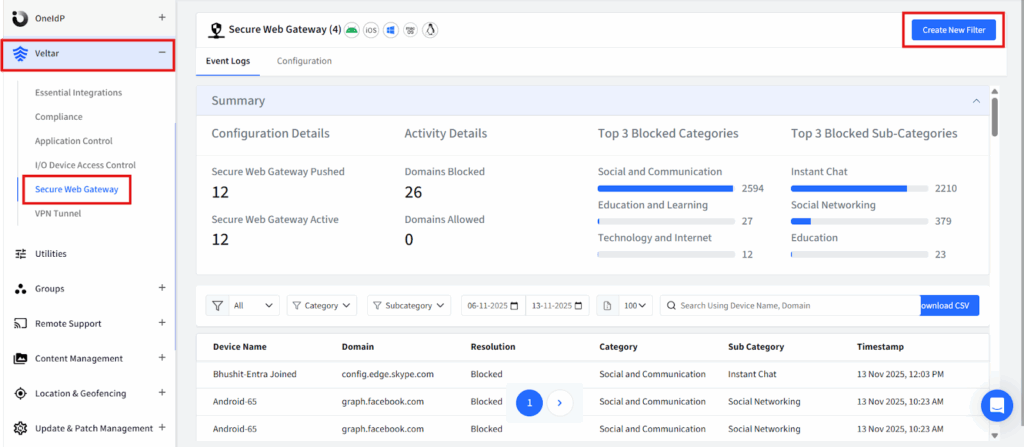
Scalefusion Veltar’s Secure Web Gateway Solution reimagines web security by integrating it directly with endpoint management workflows rather than treating it as an isolated layer. In many modern workplaces, web risk is closely tied to device risk. Unmanaged devices, outdated configurations, and policy gaps often lead to security issues. Veltar addresses this by embedding web policy enforcement into the same context that manages device posture and compliance. This approach ensures that web controls are consistently applied based on who the user is, what device they are on, and whether that device meets security standards. For hybrid and remote use cases where users frequently switch networks and locations, this tight alignment simplifies policy management and reduces gaps between device health and web security.
Key features:
- Granular web filtering: Blocks or allows access by website category, domain, or URL with high precision.
- Pattern-based domain blocking: Uses flexible domain and subdomain patterns for nuanced control.
- Custom allowlists: Lets trusted business-critical domains bypass broad restrictions.
- Cloud app restrictions: Ensures only sanctioned cloud apps are accessible based on corporate domains.
- App-level policy bypass: Excludes trusted applications from SWG restrictions to avoid workflow disruption.
- User- and device-based policies: Applies differentiated rules based on user roles and device groupings.
- Real-time enforcement: Pushes changes instantly without waiting for scheduled syncs.
- UEM-native dashboard: Centralizes web security and device management in a single UI.
- Optional Business VPN: Adds secure tunneling for encrypted traffic on untrusted networks.
Best for: Organizations that want unified device and web protection in a single pane of glass.


2. Check Point Harmony Connect
Check Point Harmony Connect is built for enterprises that require deep inspection and proactive threat prevention across web and cloud traffic. Instead of relying solely on reputation-based blocking, Harmony Connect uses advanced analysis, including sandboxing of suspicious web content, to catch sophisticated attacks that evade traditional filters. Its strength lies in inspecting activity at multiple layers, from URLs and downloads to binary execution patterns. Because it’s part of Check Point’s broader security ecosystem, it can leverage centralized threat intelligence, making it easier for large security teams to correlate web events with other threat vectors.
Key features:
- Advanced sandboxing: Executes suspicious content in isolated environments to detect zero-day threats.
- Continuous traffic inspection: Monitors web and cloud sessions in real time for malicious activity.
- Integrated DLP: Protects sensitive data from unauthorized uploads or sharing.
- Zero Trust Network Access: Applies identity and risk-based access controls to internal apps.
- Centralized policy management: Consolidates policy creation, enforcement, and reporting.
Best for: Security-forward enterprises with advanced threat prevention needs.
3. Cisco Umbrella
Cisco Umbrella has long been a go-to choice for organizations that want threat blocking as early as possible. Its DNS-layer protection interrupts unsafe connections before they ever reach the browser, providing a first line of defense that reduces exposure from phishing, malware, and command-and-control activity. Over time, Umbrella has expanded its toolkit to include best Secure Web Gateway capabilities, cloud app discovery, and analytics. Backed by Cisco Talos threat intelligence, it continuously adapts to emerging threats and offers reliable, scalable protection for diverse environments, may it be small teams or global enterprises.
Key features:
- DNS-layer threat prevention: Stops malicious access attempts before a connection is established.
- Secure Web Gateway: Adds deep content inspection and URL filtering beyond DNS-level blocking.
- Cloud app visibility: Detects and reports on usage of unsanctioned cloud applications.
- Real-time threat intelligence: Updates protections based on current global attack data.
- Centralized analytics: Provides dashboards and logs for rapid detection and investigation.
Best for: Organizations that value early threat interception and proven reliability.
4. Cloudflare One
Cloudflare One unifies Secure Web Gateway, Zero Trust access, and DNS security on Cloudflare’s global edge network. By inspecting traffic close to where users are located, it keeps performance high even with SSL decryption and threat inspection enabled. Cloudflare One also replaces traditional VPNs with identity-aware access controls, reducing complexity and improving user experience for distributed teams. It’s a strong choice for organizations that want enterprise-grade security without the operational weight of legacy appliances or fragmented tools.
Key features:
- Global edge network: Inspects traffic at edge locations to minimize latency.
- Zero Trust network access (ZTNA): Applies identity-based access control instead of network-based trust.
- Integrated DNS and DDoS protection: Combines fast DNS security with large-scale attack mitigation.
- Cloud app controls: Limits access and monitors usage of SaaS platforms.
- Cloud-native deployment: Removes the need for on-prem appliances.
Best for: Distributed teams that prioritize speed and ease of deployment.
5. Netskope Secure Web Gateway
Netskope Secure Web Gateway is built for organizations where cloud and SaaS usage dominate everyday work. Instead of treating web traffic and cloud app traffic as separate concerns, Netskope takes a data-centric approach, inspecting activity across websites and cloud applications with the same level of depth and control. This allows security teams to understand not just where users are going, but what data is being accessed, uploaded, or shared.
A key strength of Netskope is its visibility into SaaS usage. It can identify sanctioned and unsanctioned cloud apps, track risky user behavior, and apply granular controls without disrupting productivity. By combining best Secure Web Gateway capabilities with strong CASB and Zero Trust controls, Netskope helps organizations secure web access in environments that are heavily cloud-driven and distributed.
Key features:
- Cloud-aware SWG: Applies web security policies with deep visibility into cloud and SaaS traffic.
- Inline threat protection: Inspects web traffic in real time to block phishing, malware, and malicious downloads.
- Advanced data protection: Prevents sensitive data from being uploaded or shared through web and cloud apps.
- Shadow SaaS discovery: Identifies unsanctioned cloud applications and risky usage patterns.
- Zero Trust policy enforcement: Applies access controls based on user identity, device posture, and activity context.
Best for: Organizations with heavy SaaS adoption that need deep visibility and control over cloud and web activity.
6. Zscaler
Zscaler is one of the most widely deployed Secure Web Gateway platforms, designed for organizations that need global, cloud-native protection at scale. Its architecture routes traffic through a distributed security cloud, applying consistent policies regardless of user location or network. In addition to SWG, Zscaler integrates cloud access controls (CASB) and remote browser isolation, offering a comprehensive Secure Access Service Edge (SASE) framework. This makes it especially valuable for enterprises with geographically distributed users and high volumes of web traffic.
Key features:
- Cloud-native Secure Web Gateway: Processes web traffic through global cloud infrastructure.
- High-scale SSL inspection: Inspects encrypted traffic without degrading performance.
- CASB integration: Controls cloud app usage alongside web content filtering.
- Remote Browser Isolation: Keeps risky web sessions isolated from endpoints.
- Centralized policy enforcement: Applies consistent rules across regions and user groups.
Best for: Large enterprises with global operations.
7. Forcepoint ONE
Forcepoint ONE is built for organizations where data protection is a priority rather than an afterthought. It focuses on controlling how sensitive information flows across web and cloud channels, not just stopping threats. Its Content Disarm and Reconstruction (CDR) capability removes active content from files while preserving their usability, making it especially useful in regulated industries. Combined with advanced Data Loss Prevention and AI-assisted policy creation, Forcepoint ONE helps organizations enforce both security and compliance policies without excessive manual tuning.
Key features:
- Content Disarm and Reconstruction: Removes hidden threats while retaining file usability.
- Advanced Data Loss Prevention: Prevents unauthorized sharing or leakage of sensitive data.
- AI-assisted policy creation: Helps security teams build accurate policies quickly.
- Unified web, cloud, and private app security: Covers multiple attack surfaces seamlessly.
- Strong compliance reporting: Supports audit requirements and regulatory needs.
Best for: Regulated industries and data-sensitive environments.
8. Fortra Web Titan
Fortra Web Titan focuses on delivering effective web protection without operational complexity. It’s built for small and mid-sized businesses that need strong phishing and advanced malware protection but lack dedicated security teams. Its machine learning models automatically detect and block malicious domains, reducing the need for manual rule creation. Because it runs entirely in the cloud, deployment is fast and there’s no hardware to maintain, which is ideal for teams that need protection without heavy management overhead.
Key features:
- ML-based phishing detection: Automatically blocks the majority of phishing domains.
- Cloud-based deployment: Requires no on-prem hardware or maintenance.
- Directory service integration: Applies web policies based on existing user groups.
- Clear reporting dashboards: Provides easy-to-understand visibility into activity and threats.
Best for: SMBs seeking simple, affordable web security.
How to choose the right Secure Web Gateway solution?
Choosing the right Secure Web Gateway isn’t about picking the tool with the most features. It’s about selecting a solution that fits how your organization actually works. Here are a few key factors to consider when evaluating best SWG tools:
- Workforce model: If your teams are remote or hybrid, web security must work outside the office network. The right SWG should protect users consistently whether they’re on corporate Wi-Fi, home networks, or public connections, without relying on traffic being routed through a central location.
- Device diversity: Most organizations manage a mix of laptops, mobile devices, and shared or frontline endpoints. A good SWG should understand device and user context, not just IP addresses, so policies stay consistent across different device types and usage scenarios.
- Security depth vs usability: Advanced inspection and threat detection are important, but they shouldn’t slow users down. The right SWG applies strong security controls quietly in the background, without adding friction to everyday browsing or cloud app usage.
- Compliance needs: For regulated industries, visibility and control matter as much as protection. Look for strong logging, endpoint data loss prevention, and audit-ready reporting to ensure web access and data handling meet compliance requirements.
- Integration with existing tools: An SWG shouldn’t operate in isolation. The best solutions integrate with identity providers, endpoint management, and security tools, giving IT teams centralized visibility instead of another standalone console.
Invest in the right Secure Web Gateway in 2026
In 2026, Secure Web Gateway solutions are foundational security controls. They protect the most common and most exploited activity in modern work: everyday web access.
All the solutions listed here provide value. What differentiates them is how well they integrate into real workflows. Veltar stands out by unifying web security with endpoint management, reducing tool sprawl and simplifying enforcement.
Before committing, run pilot tests. Look at policy flexibility, visibility, performance impact, and how easily the solution fits into your environment.