

The top endpoint security software helps organizations protect laptops, desktops, mobile devices, servers, and other endpoints from malware, ransomware, phishing, unauthorized access, and data loss. These tools provide capabilities such as antivirus, threat detection, endpoint monitoring, patching, device control, encryption, vulnerability management, and response actions to secure business devices across office, remote, hybrid, and frontline work environments.
Key takeaways
Modern endpoint security software helps businesses secure devices, detect threats faster, and maintain visibility across increasingly distributed IT environments.
- Endpoint Risks Are Growing: Remote work, BYOD adoption, and unmanaged devices have expanded the attack surface, making endpoint protection a critical part of enterprise cybersecurity strategies.
- Core Capabilities Matter: The best endpoint security platforms combine threat detection, ransomware protection, device control, behavioral analytics, and automated incident response within a centralized management console.
- Top Solutions Compared: Leading endpoint security tools in 2026 include CrowdStrike Falcon, Microsoft Defender for Endpoint, SentinelOne, Sophos Intercept X, VMware Carbon Black, and other enterprise-focused platforms.
- Beyond Antivirus Protection: Modern endpoint security software goes beyond signature-based antivirus by using AI, machine learning, and real-time monitoring to identify advanced and zero-day threats.
- Choosing the Right Platform: IT teams should evaluate endpoint security solutions based on deployment flexibility, integration support, cross-platform coverage, ease of management, and response automation capabilities.
Having the best endpoint security solutions is similar to setting up security cameras, alarms, and maybe even motion sensors to cover every angle of your house. Just like your house, you’re guarding your business against threats, only in this case, they are digital.
From sensitive data to intellectual property, your organization’s endpoints are the first line of defense against cyberattacks. That’s where top-tier endpoint security software steps in, creating that invisible yet impenetrable wall around your network.
With so many options out there, choosing the right endpoint security software is like picking the right bodyguard; it’s gotta be reliable, proactive, and sharp.
From preventing data breaches to thwarting ransomware and insider threats, these solutions are tailored to make your digital environment much safer. Let’s find out the best endpoint security solutions and learn why they are must-haves in 2026.
Enterprise endpoint security platform: Side-by-side comparison
| Criteria | Scalefusion Veltar | Sophos | Microsoft Defender for Endpoint | CrowdStrike Falcon | SentinelOne | TrendAI Vision One | Cisco Secure Endpoint | ThreatDown (by Malwarebytes) |
|---|---|---|---|---|---|---|---|---|
| Best for | UEM integrated with endpoint-centric secure web gateway and automated compliance | Prevention-first security & integrated ecosystem | Native Windows enterprise synergy | Proactive threat hunting & managed EDR | Automated, AI-driven machine-speed response | Multi-layered XDR across hybrid workspaces | Cisco network infrastructure ecosystems | SMB endpoint security with low management overhead |
| OS Support | Windows, macOS, Linux, Android, iOS | Windows, macOS, Linux, Android, iOS | Windows, macOS, Linux, Android, iOS | Windows, macOS, Linux, Android, iOS | Windows, macOS, Linux, Android, iOS | Windows, macOS, Linux | Windows, macOS, Linux, Android, iOS | Windows, macOS, Linux |
| Device Control | Yes (USB/bluetooth, and I/O restrictions with native UEM endpoint management) | Yes (USB/peripheral access rules; Sophos Mobile required for full UEM/MDM) | Yes (Defender peripheral access policies with Microsoft Intune for device and hardware management) | Yes (USB/peripheral policies and device isolation; third-party integrations required for UEM) | Yes (USB and Bluetooth restrictions with device isolation; UEM requires third-party integration) | Yes (Storage/USB restrictions and device isolation; additional Trend solutions required for broader MDM) | Yes (USB storage restrictions and device isolation; broader device management requires other Cisco platforms) | Yes (USB/peripheral blocking and device isolation; no native UEM-level hardware management) |
| DLP (Content-Aware) | Basic/Contextual aware (Requires full UEM enrollment) | Basic (Predefined templates, text string matching for Windows only) | Yes (Deep native hooks into Microsoft Purview DLP) | No (Peripherals only; requires 3rd-party software integration) | No (Peripherals only; requires 3rd-party software integration) | Yes (Available via native Trend Vision One DLP Module add-on) | No (Network-layer focused; needs Cisco Secure Email/Web) | No (Strictly peripheral device blocking) |
| Patch Management | Yes (Native OS patch policies via UEM) | Basic (Vulnerability scan visibility only; no active deployment) | No (Vulnerability tracking only; active patching requires Microsoft Intune) | Yes (Native patching via Falcon Spotlight / Patch modules) | No (Vulnerability detection only; requires third-party tools to push patches) | Yes (Supports virtual patching & vulnerability shields) | No (Requires integration with Cisco vulnerability tools) | Yes (Native patch execution in Advanced & Elite tiers) |
| Pricing | $3/device/month | Available upon request | $12/user/month | $59.99/device/year | $179.99/endpoint | Available upon request | Available upon request | $345/year for a minimum of 5 endpoints |
| Core Limitations | Lacks advanced, deep EDR behavioral analytics engines | Heavy endpoint client footprint; separate consoles for legacy tools | Highly complex licensing logic; cross-OS feature parity gaps | Advanced features require buying individual extra modules | Lacks native endpoint content-level data protection engines | High configuration overhead and data telemetry tuning curves | Complex ecosystem curve if not using Cisco firewalls/networks | Advanced automation features locked behind highest bundles |
8 Best endpoint security solutions in detail
1. Scalefusion Veltar
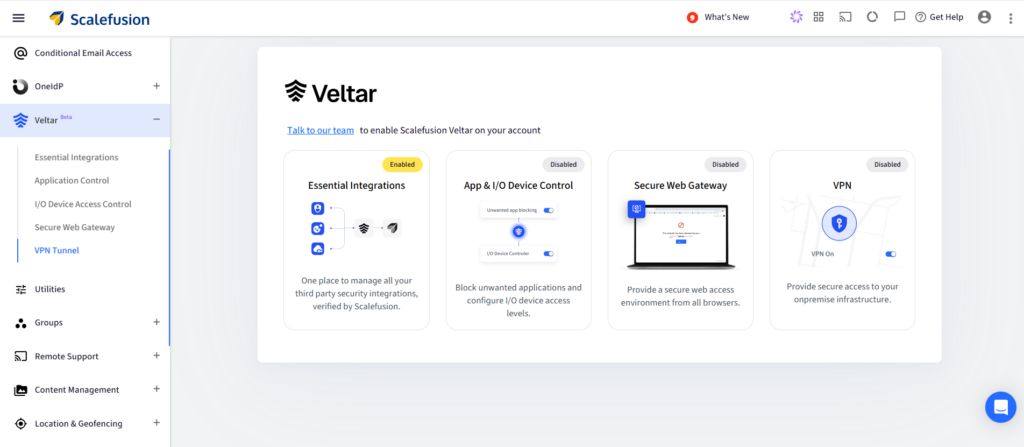
Scalefusion Veltar is redefining endpoint security with its unified, future-proof solution tailored for modern businesses. Designed for ITOps and SecOps leaders, Veltar simplifies the complexities of managing and securing endpoints across macOS, iOS, Windows, Linux, and Android. It enables security teams to stay agile and innovative while maintaining protection against evolving threats.
Veltar simplifies compliance, endpoint data loss prevention, secure web access, and endpoint security controls from a centralized dashboard.
Veltar equips security teams with enterprise-grade capabilities, including CIS Benchmark enforcement (with automated remediation), Device Trust from Android Enterprise, Secure Web Gateway (SWG), Application & I/O Device Control, and VPN tunneling. By combining automated compliance drift monitoring with granular exfiltration controls, Veltar helps organizations secure hybrid workforces, maintain audit readiness, and mitigate risks without adding another standalone management layer.
Key Features:
- Web content filtering: Blocks access to specific domain categories, such as social media and adult content, to foster a secure digital environment and protect against malicious URLs and phishing attacks.
- Endpoint DLP: Prevent data leaks with multi-layered exfiltration controls, including USB device blocking, Bluetooth restrictions, network access limits, and cross-application data-sharing prevention (clipboard/copy-paste blocking).
- CIS benchmark enforcement: Apply supported CIS compliance configuration rules, monitor deviations, and remediate selected non-compliant settings across supported devices.
- Device trust: Integrated with Device Trust from Android Enterprise to ensure that only trusted and compliant devices, regardless of whether they’re company-owned or employee-owned (BYOD), can connect to business apps and resources.
- VPN tunnel: Provides encrypted, anonymous data transmission over public networks, allowing secure access to internal corporate resources and safeguarding data in motion.
- Integrated mobile threat defense (MTD): Seamlessly integrates with Check Point Harmony Mobile, enabling organizations to deploy its mobile threat defense capabilities to supported managed Android and iOS devices through Scalefusion.
Reasons to Buy:
- Multi-OS endpoint security and compliance: Supports macOS, iOS, iPadOS, Windows, Linux, and Android, making it suitable for organizations with diverse device ecosystems.
- Enhanced security posture: Equipped with web content filtering, Endpoint DLP, and SWG to enhance the organization’s defense against cyber threats.
- Simplified management: The singular intuitive dashboard simplifies the management of device security, reducing administrative overhead.
- Scalability: Designed to accommodate organizations of various sizes, providing flexibility as the business grows.
Limitations:
- Tailored Security Needs: Veltar’s broad security approach offers the level of customization some businesses may not require.
Pricing:
- Scalefusion Veltar Starts at $3/device/month/billed annually
- A 14-day free trial is offered
(Note: This is an annually-billed add-on plan that requires an active Scalefusion UEM subscription)


2. Sophos
Sophos combines endpoint protection with a straightforward cloud dashboard, making it easy for IT teams to deploy. It employs a prevention-first approach to threats, blocking them through a range of methods, including AI-based detection, behavioral analysis, and ransomware protection.
Sophos provides enterprise networks with anti-exploit, deep-learning malware detection, and adaptive attack protection to enhance security. It monitors file contents for malicious encryption, blocking offending processes on the victim’s computer and on compromised network-connected devices.
Key features:
- Web protection: Monitors outbound browser connections and blocks malicious websites.
- Attack blocking: Provides endpoint protection with advanced defenses that prevent threat actors from escalating during an ongoing attack.
- Attack analysis: Offers detailed insights about how an attack occurred, helping prevent future security incidents.
- Device isolation: Isolates endpoints from the network during a threat and until threat investigation is complete.
- Scalability: Suited for SMBs that want simple and comprehensive auto-security software.
Reasons to buy:
- Robust protection: Actively blocks any threats and isolates them from the network to prevent a wider spread.
- Deep learning: Utilizes AI learning to identify threat patterns and remain proactive in its approach.
- User experience: Easy to learn and simple to deploy.
Consideration:
- Performance issues: Can cause performance drops on the device.
Pricing:
- Available upon request
- Offers a 30-day free trial.
3. Microsoft Defender for Endpoint
Microsoft Defender for Endpoint is a comprehensive endpoint protection software built into the Microsoft ecosystem, designed for organizations using Windows, Microsoft 365, and Azure. It helps enterprises prevent, detect, investigate, and respond to advanced threats on endpoints, including laptops, phones, tablets, PCs, access points, routers, and firewalls.
Key features:
- High compatibility: Built for Windows, it offers unparalleled visibility into the operating system.
- Easy integration: Zero deployment friction since the agent is already built into Windows operating systems, requiring only activation.
- Automated detection and response: Automates detection and response processes related to threats to reduce labor-intensive activities and increase efficiency.
- Additional features: Comes with a vast suite of tools such as Intune, Configuration Manager, and automated remediation.
Reasons to buy:
- Native OS: Being native to Windows, it comes pre-installed in the system as part of Microsoft Security and only requires activation.
- User experience: Most employees are familiar with the Windows interface, making it easier to navigate.
- Security: Provides strong baseline protection and compliance controls with minimal setup.
Considerations:
- Multiple portals: Lack of clarity in navigating through multiple portals for effective policy creation.
- Cost: Advanced features require higher-tiered licences.
Pricing:
- Starts at $12/user/month/billed annually
- 1-month free trial available
4. CrowdStrike Falcon
CrowdStrike Falcon is a cloud-native endpoint protection software. Known for advanced threat intelligence and lightweight agent design, it utilizes behavioral analytics and real-time threat intelligence to prevent malicious threats from breaching.
Key features:
- Cloud-native architecture: Uses a single lightweight agent that offloads heavy analysis to the cloud, ensuring minimal impact on device performance.
- Real-time threat response: Provides up-to-date threat intelligence and proactive protection in real-time.
- Remote access: IT teams can remotely access endpoints and run commands to remediate threats instantly.
- Lightweight: Works through a lightweight single-agent deployment across Windows, macOS, and Linux.
Reasons to buy:
- Accuracy: Highly accurate and precise at detecting threats.
- Speed: Boasts high-speed detection and deployment.
- Scalability: Best suited for large-scale organizations managing thousands of endpoints and having multiple security measures.
- Performance: Minimal impact on the performance of the endpoint.
Considerations:
- IT load: Requires a dedicated team of IT professionals to set up and analysts to drive it.
- Cost: Premium pricing compared to other solutions, and requires additional modules for advanced features.
Pricing:
- Starts at the base annual plan of $59.99 per device
- Provides a 15-day free trial
5. SentinelOne
SentinelOne offers next-generation endpoint protection. Using AI-powered endpoint security measures, it positions itself as a solution that requires no human intervention.
Using its diverse suite of features, SentinelOne can reverse ransomware damage with a single click, making it well-suited for organizations that give top priority to preventing data loss. It boasts strong adaptability to evolving cyber threats and provides automated protection, threat detection, and response capabilities.
Key features:
- Auto-rollback: Automatically restores encrypted or deleted files to their pre-infection state, effectively undoing the adverse impact of a ransomware attack.
- Manage attack surface: Identifies all IP-enabled devices on your network and evaluates them based on the risks they pose and automatically extends protections.
- Vast coverage: Performs wide prevention, detection, and response actions across all endpoints.
Reasons to buy:
- Highly automated: Requires little human interaction for prevention and remediation actions.
- Accuracy: Delivers accurate, real-time threat detection with contextual relevance that eliminates most false positives.
Considerations:
- Resource-heavy: Can be heavy on the device, as per usage, creating a performance lapse.
- IT load: While it is mostly automated, IT admins may face a steep learning curve to fully understand its functionalities.
- Cost: Priced at a premium, with additional features requiring a higher-tier plan.
Pricing:
- Starts at $179.99 per endpoint
6. TrendAI Vision One
TrendAI Vision One endpoint security platform combines traditional antivirus software with modern threat detection techniques to deliver well-rounded security across all endpoints. Its all-in-one platform reduces the complexity of managing a diverse ecosystem with broad endpoint coverage, including servers, IoT devices, and legacy systems.
Key features:
- Virtual patching: Addresses vulnerabilities until official patches are released, protecting the more vulnerable endpoints from known and unknown vulnerabilities.
- Cloud-based: Makes central management and report generation easy.
- Automation: Provides automated incident response to reduce manual intervention and minimize potential damage.
Reasons to buy:
- Context-rich detection: Provides detailed insights to correlate events and accelerate investigation and response.
- Unified security platform: Integrates endpoint, cloud, network, email, and identity protection into a single view for centralized control.
- Scalability: Suited for SMBs that require simplified management and protection.
Considerations:
- Heavy usage: May increase the load on the system, creating a heavier footprint.
- Limited configurations: Fewer configuration customization options for larger organizations.
Pricing:
- Available upon request
- Provides a 30-day free trial
7. Cisco Secure Endpoint
Cisco Secure Endpoint (formerly known as AMP for Endpoints) is a robust enterprise security software designed to protect businesses from advanced threats, malware, and ransomware. Combining cloud-based management with deep visibility and analytics enables businesses to detect, prevent, and respond effectively to endpoint security threats. With seamless integration into the Cisco ecosystem, Secure Endpoint is ideal for organizations seeking an all-inclusive security solution backed by advanced threat intelligence.
Cisco Secure Endpoint is a cloud-native solution designed to detect, respond to, and recover from cyber threats, reducing remediation times by up to 85%.
Key features:
- Endpoint detection and response (EDR): Offers both built-in and managed EDR capabilities, including threat hunting and integrated risk-based vulnerability management through the Kenna Security tool.
- USB device control: Allows the creation, viewing, and management of rules to ensure only approved USB devices are used, providing deep visibility into events like blocked devices during compromise investigations.
- Integrated extended detection and response (XDR): Provides a unified view, simplified incident management, and automated playbooks with Cisco XDR, offering a broad approach to extended detection and response.
- Built-in Talos threat hunting: Enables proactive threat hunting by Cisco’s security experts, mapping to the MITRE ATT&CK framework to prevent attacks before they cause damage.
Reasons to buy:
- Comprehensive protection: Combines next-generation antivirus with advanced EDR capabilities to safeguard endpoints against sophisticated threats.
- Scalability: Suitable for businesses of all sizes, offering flexible deployment options and integration with other Cisco security solutions.
- Proactive threat hunting: Leverages human-driven threat hunting to identify and mitigate potential risks before they impact the organization.
Considerations:
- Complexity: Advanced features may require a learning curve for IT teams unfamiliar with Cisco’s security ecosystem.
- Cost considerations: While offering features, the solution may represent a significant investment, particularly for small and medium-sized businesses (SMBs).
Pricing:
- Available upon request
8. ThreatDown
ThreatDown’s Endpoint protection software is an award-winning, AI-powered solution designed to safeguard your organization’s workstations, servers, and other endpoints from advanced cyber threats. It offers next-generation antivirus capabilities to prevent threats from infiltrating your environment, all while maintaining a simplified management experience.
Key features:
- Accurate verdicts: Employs precise threat detection and proactive blocking mechanisms to minimize false positives, ensuring legitimate endpoint activities remain uninterrupted.
- Simplified management: Provides real-time updates and effortless threat management through a user-friendly console, streamlining administrative tasks.
- Small footprint: Utilizes a single, lightweight agent that is easy to deploy and has a negligible impact on system resources, preserving endpoint performance
- AI-powered protection: Integrates multiple AI-driven prevention technologies to deliver defense-in-depth, stopping threats before they penetrate your environment.
Reasons to buy:
- Comprehensive protection: Combines endpoint security operations, full disk encryption, and advanced threat defense to provide a holistic cybersecurity solution.
- Ease of management: The cloud-based console offers single-pane-of-glass management, simplifying oversight and control of security measures.
- Regulatory compliance: Full disk encryption aids in meeting data protection regulations, reducing the risk of non-compliance penalties.
- Scalability: Suitable for businesses of all sizes, with flexible deployment options to accommodate varying organizational needs.
Considerations:
- Training required: Organizations without dedicated IT security personnel might require initial training to fully leverage all features.
- Resource requirements: Advanced endpoint features may demand higher system resources, which could impact performance on older hardware.
Pricing:
- Annual pricing starts at $345/year, with a minimum requirement of 5 endpoints per subscription
- A 15-day free trial is available
Best endpoint security solutions by use case
| Use case | Best choice | Why |
|---|---|---|
| Endpoint web security, compliance, and DLP | Scalefusion Veltar | Combines endpoint-centric web security, automated compliance, and Endpoint DLP |
| Prevention-focused endpoint protection | Sophos | Combines prevention, detection, response, and endpoint security capabilities |
| Microsoft-centric environments | Microsoft Defender for Endpoint | Integrates with Microsoft's broader security and management ecosystem |
| Advanced EDR and threat protection | CrowdStrike Falcon | Focuses on endpoint detection, response, threat intelligence, and threat hunting |
| Automated endpoint protection | SentinelOne | Emphasizes automated prevention, detection, response, and remediation |
| Unified XDR and endpoint security | TrendAI Vision One | Extends endpoint protection across broader security layers through its XDR platform |
| Cisco security environments | Cisco Secure Endpoint | Integrates endpoint protection with Cisco's broader security ecosystem |
| Simplified endpoint security for SMBs | ThreatDown | Provides endpoint protection with additional capabilities available through its broader platform |
Choose the best endpoint security software to strengthen your security posture
With the stakes higher and more sophisticated threats, securing your organization’s endpoints is no longer about keeping the bad actors out; it’s about staying ahead. Investing in the best endpoint security solutions ensures that your business can stay one step ahead of the curve.
Each of the eight software we explored brings something unique to the table, but all share a commitment to keeping your data safe and your systems running smoothly. So, when it comes to securing your business, don’t settle for anything less than the best. The future of endpoint security strategy is here, and it’s time to upgrade your defenses.

FAQs
1. What is the best endpoint security software for businesses?
The best option depends on your organization's size, devices, security requirements, and existing infrastructure. Solutions such as Veltar, Sophos, Microsoft Defender for Endpoint, CrowdStrike Falcon, and SentinelOne take different approaches to endpoint protection.
2. Is endpoint security the same as antivirus?
No. Antivirus primarily detects and blocks malware, while endpoint security covers broader capabilities such as threat detection and response, device control, vulnerability management, application security, and data protection.
3. Do small businesses need endpoint security software?
Yes. Endpoint security helps small businesses protect devices and data against malware, ransomware, phishing, and other threats without requiring a large security team.
4. How do I choose endpoint security software?
Consider OS and device coverage, threat detection and response, device and application control, DLP, vulnerability management, integrations, deployment, and cost.
5. What endpoint security features should enterprises look for?
Enterprises should look for EPP/EDR, threat detection and response, vulnerability management, device and application control, DLP, threat intelligence, centralized management, automation, reporting, and support for their operating systems and security infrastructure

