

The right unified endpoint management solution should help your organization centrally manage, secure, monitor, and support all endpoints, including laptops, desktops, smartphones, tablets, rugged devices, and shared devices, across different operating systems. To choose the best UEM solution, businesses should evaluate platform support, security capabilities, app and patch management, automation, remote troubleshooting, scalability, integrations, ease of use, and total cost of ownership.
Key Takeaways
Choosing the right unified endpoint management solution helps organizations centrally manage diverse endpoints, strengthen security, automate IT operations, and support future device growth without adding unnecessary complexity.
- Start with Business Requirements: Identify the operating systems, device types, ownership models, workforce needs, and industry-specific use cases the UEM platform must support before comparing vendors.
- Prioritize Unified Management: The right UEM solution should provide a single dashboard for device enrollment, policy enforcement, application deployment, updates, compliance monitoring, and remote troubleshooting.
- Evaluate Security and Compliance: Look for capabilities such as zero-trust access, device posture checks, data loss prevention, automated remediation, and compliance reporting to reduce endpoint risks.
- Check Enrollment and Integration Options: Support for Android Zero-touch, Apple Automated Device Enrollment, Windows Autopilot, directory services, and business applications can simplify deployment and existing workflows.
- Consider Scalability and Total Cost: Choose a UEM platform that can accommodate future device growth, additional use cases, and evolving security requirements while remaining manageable and cost-effective.
Unified endpoint management (UEM) has positioned itself as the silent backbone on which industries are expanding. This expanse across multi-platform devices such as Android, iOS, and Windows, working on a variety of device profiles, needs a command center to oversee the device operations, upkeep, and management.
As the number of devices increases and they start to scatter across the globe, their security becomes a growing concern for organizations. With the ever-increasing cyber threat, a single breach could lead to devastating results across the board. It is thus paramount to ensure that security remains airtight through all devices regardless of their location and profile.
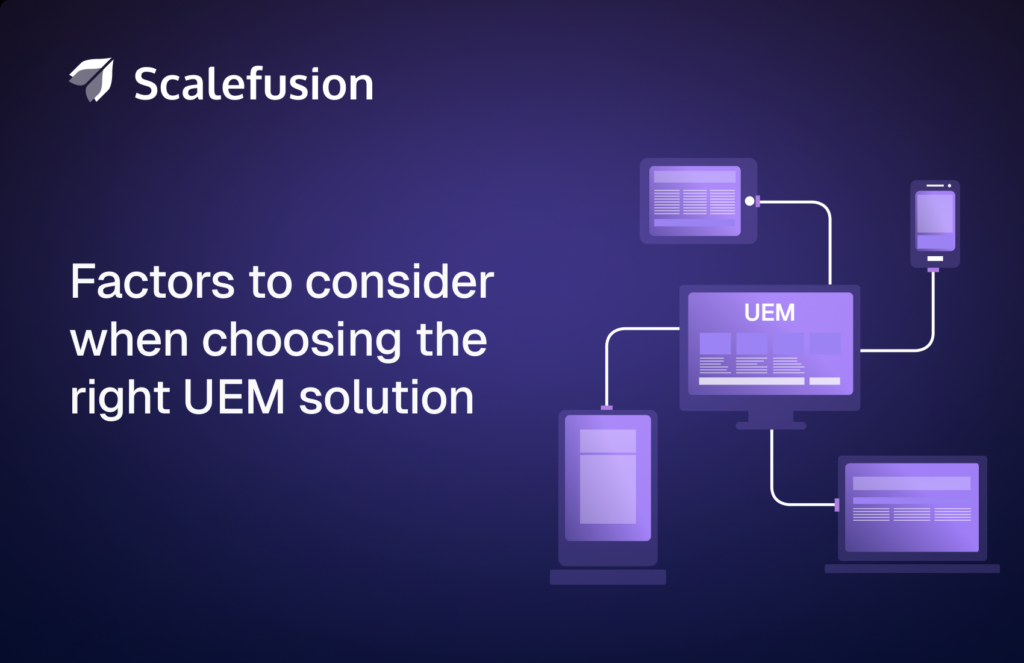
The best UEM solution should cater to your organization’s specific needs and bring order to the chaos, just like Luke Skywalker brought balance to the force. Be it increasing the visibility of operations, reducing IT load, or controlling the flow from a single point of command.
What is UEM?
To choose the right UEM solution, you first have to know what it is that you are looking for. Unified Endpoint Management is a comprehensive approach to managing and securing all the endpoints in an enterprise network. It streamlines and simplifies the management of diverse endpoints, including smartphones, tablets, laptops, desktops, wearables, VR/AR, and other IoT devices.
UEM solutions compile several functions into one system, such as device provisioning, app distribution, policy enforcement, remote troubleshooting, data security, and device lifecycle management. IT teams can apply security settings, track device health, and ensure compliance, all from a single dashboard.
Unlike older mobile device management (MDM) tools that manage devices separately based on type or OS, UEM provides a unified approach. It streamlines IT operations, reduces complexity, and supports remote and hybrid workforces. It is designed to adapt to the growing mix of endpoints, offering scalability and control for businesses of all sizes.
Want to see how a UEM solution works in practice?
Take a quick look at Scalefusion.
What can the right UEM solution do for you?
The best UEM solution comes with tremendous advantages over traditional device management methods. Here’s a small look at what they can do for you:
Consolidated management: UEM works on a single-solution framework that provides a centralized platform for endpoint management, helping you avoid complications of different software on multiple platforms.
Seamless workflow: UEM solution allows organizations to seamlessly manage devices, apply policies, update applications, troubleshoot any errors, and create a fleet-wide report with ease.
Solidify security: UEM tightens security with constant updates from all devices and automated remediations in case of a breach. This helps IT admins keep track of suspicious activities across all endpoints.
Enhanced visibility: By having a single watch tower to overlook the entire workflow of all devices, UEM gives organizations a clear view of how all operations are being carried out. This also allows for precise fault-finding.
Unified ecosystem: The biggest benefit of employing the best UEM solution is that it removes the diversification of devices being managed based on their OS and profiles. Furthermore, the unification of devices puts them under a single banner of the company.
Lowering operational cost: With features like remote troubleshooting, mass patch rollouts, and security remediations, the need for having different IT teams for different tasks is drastically reduced. This translates to lower operating costs.
What makes a UEM solution the best?
With everyone searching for the right UEM solution, it is natural that the market will be flooded with a plethora of options. An ideal UEM solution must comprise all the latest features being used across the industry, so you don’t fall behind.
Here’s a feature list of what the best UEM solution should be capable of:
Compatibility: The UEM solution should be compatible with all your organization’s devices and any custom OS devices without requiring secondary support systems. It should also seamlessly integrate with any existing directories and applications.
Enrollment: The UEM solution should support key enrollment methods, such as Android Zero-touch, Apple ADE, Windows Autopilot, QR code, IMEI/Serial number, and others. This allows devices to be easily enrolled into the UEM system through both bulk and custom enrollments.
One command center: The UEM solution should manage all your devices, security measures, user policies, and updates from a single dashboard. This reduces the IT fatigue of switching between different services for various functions by having it all managed from a single point of control.
Security features: The UEM solution should provide a comprehensive suite of tools to keep everything in check and further enhance the secure network. Having integrated security features such as zero trust, endpoint data loss prevention (DLP), and single sign-on (SSO) helps further enhance the security posture of your organization.
Ease of use for IT: The UEM solution should reduce IT load by eliminating the need for manual labor across thousands of devices and, in turn, saving costs. The simpler a UEM is for an IT admin to onboard new and existing users and help troubleshoot any queries, the better.
Automation and compliance: The UEM solution should automate compliance tasks by setting up defined policies that are enforced anytime there is a lapse. This reduces the time required for correcting any shortcomings and keeps the company on a consistent track in making its data secure.
Remote access management: The UEM solution should allow for remote management of devices for troubleshooting, patch management, and policy reconfiguration. This is crucial for organizations that employ a vast number of remote workers who need constant support from the command center.
Profile configuration: The UEM solution should create custom user groups based on certain parameters, such as OS, use case, and device profile, from a single point of control. Being able to categorize devices and, by extension, their users helps monitor the workflow better and generate accurate performance reports.
Choosing the right UEM solution for your enterprise
You know what UEM is and what it brings to the table, but how do you know which one deserves a seat at your table?
The simple answer is an old-fashioned checklist.
You jot down your specific needs and then cross-check which UEM solution fits the bill best. Below are certain factors to consider:
1. Availability of necessary features
While all organizations need a UEM solution, their needs change from industry to industry. A logistics company will need constant tracking of its devices, while a retail company will need in-depth management of the devices on the floor.
Thus, you need to make sure the best UEM solution you choose has your desired features present.
2. Device profiling and modes of devices used
Just as your organization caters to the different user needs, your devices need to match their specific use cases. From kiosk devices for information display to company devices being used for remote employees, each device will work on different profiles. The UEM solution needs to manage them all together while supporting their individual functions.
3. Scope of expansion
With time, your organization will continue to grow, and so will the number of devices you deploy. The best UEM solution should not be a hindrance to your expansion, be it through feature limitation or overbearing costs.
4. Zero trust
Zero trust is no longer an add-on and instead the foundation of modern UEM platforms. Oragnizations need continuous authentication and real-time device posture checks to ensure their security remains top-notch.
Choosing the right UEM solution should further enhance your security and drastically reduce the threat surface area by employing a zero trust approach across the board.
5. Compliance mandates
Many industries, such as education, hospitals, and banking, need to maintain high levels of compliance to be trusted by users. This translates to the deployed devices being compliant with their handling of sensitive information.
The UEM solution you pick should help you maintain these levels of compliance and let you know whenever an action is required to remediate a compliance lapse.
6. Employee experience
At the core of making the right choice of UEM solution, the user will be the person who will benefit the most. Your chosen UEM solution should be simple enough for the employee to carry out their daily operations without any friction.
7. Cost evaluation
Not all organizations run a 100,000 device fleet; some run 50,000, while others only have a thousand. Keeping the budget in mind is important to ensure you are not stretching it too thin on just the management of the devices and hampering the operations.
Your UEM solution should fit this budget without creating hurdles in the managed resources.
Right tool for the right task
Taking the increasing digitalization into consideration, choosing the right UEM solution for your organization is crucial to your long-term success. Organizations that choose the UEM solution that meets their requirements will see a more consistent growth chart with fewer fragmentations compared to those that hastily adopt one.
With the best UEM solution, you gain a better understanding of your devices, through which you can improve upon them and deliver better results.
Scalefusion is one such UEM solution that caters to all your present and future endpoint management needs, so you can keep marching on without any hurdles.
Start managing your endpoints across the board and beyond with Scalefusion UEM.
Sign up for a 14-day free trial of Scalefusion UEM.

